Jul 10, 2018
Preparing for Influenza Epidemics by Making Flu Medications Accessible
During flu season, those who contract the flu are prescribed and instructed to take antiviral drugs, which are the only form of treatment for influenza, and may reduce and shorten flu-like symptoms that can lead to serious illness. To be most effective, it’s recommended that these drugs are taken within 48 hours of presenting symptoms. In the event of a severe influenza season or pandemic, the supply of antiviral drugs may be inconsistent, resulting in patients having a difficult time quickly identifying where to locate these critical medications nearby.
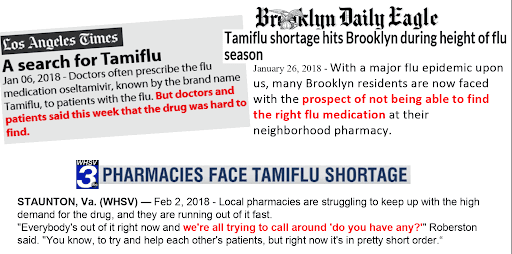
Health professionals and the public needed a system that showed the nearest location of antivirals. In an antiviral drug shortage, people may have to visit multiple pharmacies before they are able to find one that can fulfill their prescription. Doctors needed a prescription resource for their patients, and those who contracted the flu needed a quick way to know where to get their medication.
Boston Children’s Hospital began addressing the opportunity by developing MedFinder.org, a digital prototype to track antiviral supplies nationwide. The prototype leveraged much of Vaccine Finder’s model, which already stored large amounts of pharmacy data: store locations, hours, contact information, and vaccine supplies. Adding data on influenza antiviral drugs was a natural enhancement.
After testing the prototype as a concept, BCH, in partnership with the Centers for Disease Control and Prevention (CDC), approached Exygy to scale the development into a production ready version of MedFinder. This development was divided into three phases.
Phase 1: Scale Vaccine Finder’s Infrastructure
Our engineering team adopted Vaccine Finder’s architecture, and scaled its capability to work under heavy traffic. We redesigned the MedFinder architecture to perform under conditions such as a national epidemic. The platform underwent performance and stress tests, proving that users, pharmacies, and the CDC would be able to securely share and process data rapidly during a critical time.
Phase 2: Design for Inventory Management
Our design team began by conducting interviews to learn how supply needs to be communicated quickly and effectively for proper decision making. The team wanted to understand what information was the most useful to the CDC, and how it should be visualized in order to make critical decisions in time-sensitive situations. We developed a public health dashboard for MedFinder team members to analyze supply level data.
Phase 3: Design for Public Value
Our team developed detailed proto-personas, allowing us to navigate MedFinder through the eyes of common user profiles. Our design team also built an intuitive interface that would allow the public to quickly identify the location of the nearest pharmacy that’s able to fulfill their prescription. Phase 3 included multiple design iterations based on feedback before developing the application, ensuring a product that is truly in-step with users’ needs.

The option to fulfill multiple prescriptions (for multiple sick family members, etc) makes the search process faster and more effective.
As a result, patients can now fulfill their prescriptions by searching for their specific drug type and dosage in stores within their zip code:
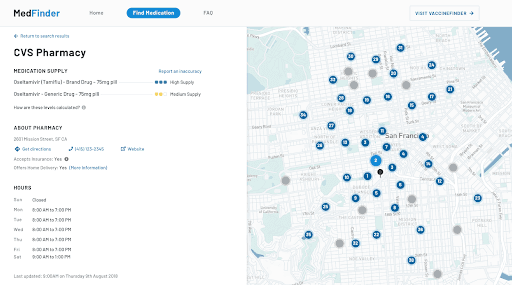
As pharmacies report their inventory levels at stores across the country, MedFinder is able to share live updates to those in search of flu antivirals to minimize the severity of influenza outbreaks. MedFinder is being piloted in partnership with major pharmacy chains, and is in the process of expanding to every antiviral drug provider in America.
The 2017-2018 flu season was one of the most severe and prolonged outbreaks in recent years. The CDC reports over 30,000 confirmed influenza-related hospitalizations were reported during this flu season. As the flu progressed around the US, targeting children and seniors, most of the country suffered from mass-shortages of flu antiviral drugs. It was clear to many in the health sector that we need an infrastructure that we do all we can to prevent any future outbreak from taking a similar toll by ensuring all have access to antivirals in a timely manner.
MedFinder has the potential to dramatically improve how our country responds to an influenza epidemic. It is the result of several key partners dedicated to building a healthy and resilient population. Boston Children’s Hospital envisioned a platform that informs the CDC in their communication with industry partners to make calculated decisions that impact access to these critical flu medications around the nation. Together, we have built a platform for everyone who contracts the flu to quickly find the nearest antiviral drugs – our best hope at minimizing the severity of flu symptoms for millions of Americans.
Our team is very impressed with the strategic approach and user-centered design practices that Exygy provided for every aspect of this platform. We are grateful for their commitment and dedication to the success of the product!
— Kara Sewalk, Project Manager, Innovation and Digital Health Accelerator, Boston Children's Hospital